The Stone Kingdom
The EmigrantsThe Stone Kingdom names both Karl Oskar Nilsson’s farm at Korpamoen and the hard boundary of what that land can offer him. The title’s irony is built into the contrast between a king and his realm: Karl Oskar is called king, but his kingdom is a small holding where stones limit cultivation, debts constrain choices, and drought can render even the seed unproductive. As the family prepares to leave, the land’s limits persist in memory and material objects, while a measure of Swedish earth travels with the emigrants across the sea.
A Kingdom of Seven Acres
Karl Oskar inherits the fields his father, Nils Jakob’s Son, has cleared. His father’s work lets him plow and sow established ground, but it does not enlarge the farm. At seven acres, much of them poor, sandy soil, Korpamoen can support his parents, his wife, and himself, but not a horse. A horse could help him earn money hauling timber; keeping one would require three more acres and winter stores of oats. The farm’s acreage therefore limits not only his harvest but also his ability to seek additional income.
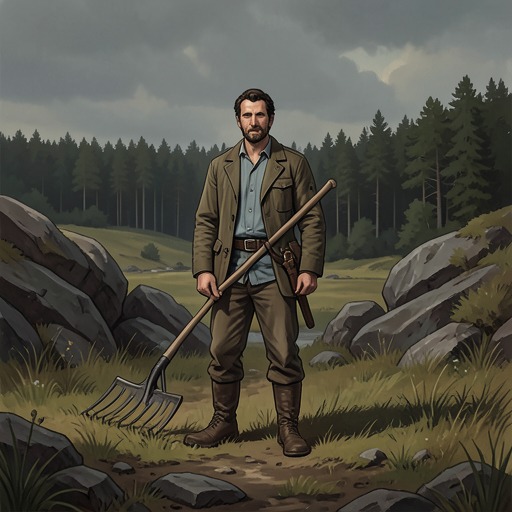
The possibility of expanding the cultivated land seems at first like a practical answer. Karl Oskar walks over the unbroken parts of Korpamoen with an iron bar, testing the ground as he goes. Spruce woods, knolls, sandy plains, juniper and pine roots, low swamps, moss, cranberries, hillocks, and tussock-filled meadows all give way to the same result: stone. His father has already brought all the arable land within the boundaries under cultivation. Karl Oskar cannot find even a tenth of an acre left to clear.
That discovery closes off the hope that effort alone can make the farm larger. To gain more arable land, the acres would have to be stretched beyond the dimensions God gave them. Instead, Karl Oskar must live with the seven acres and the stones above and below the soil. The narrative turns the repeated obstruction into the farm’s defining image: a stone kingdom ruled by a man who cannot continue creation where it has stopped.
Labor, Authority, and the Limits of Choice
The stones connect Karl Oskar’s predicament to a wider world in which people’s labor and movement are restricted. Robert Nilsson, working at Nybacken, experiences another kind of confinement. His days begin at four in the morning, and he serves the farm’s people as well as its animals. He must care for four horses, filling their mangers, cleaning their stalls, bringing hay and oats, cutting fodder, and carrying water. The work leaves him exhausted, and the animals’ continual needs make the hired hand’s service seem nearly continuous.
The service year is 358 days, with only one free week. Robert recognizes early that he wants to escape his human and animal masters, but the rules of the farm normalize obedience and discipline. After Aron of Nybacken strikes him, Robert does not report the incident. He believes that a lazy or disobedient servant may be punished under the servant law, a principle reinforced at the yearly examinations by Dean Brusander. The episode shows how authority works not only through a master’s control of a worker’s time, but also through the worker’s acceptance of the rules as legitimate.
The voyage to America does not immediately offer an uncomplicated alternative. Shipboard provisions are rationed weekly; passengers must take turns using the galley, clean the hold before receiving water, and obey the captain’s orders. After a week at sea, Robert judges that a farmhand on land has more freedom than a seaman. He compares the seamen’s tightly packed bunks and restricted movement aboard ship with the farm service he knows. These parallels widen the Stone Kingdom’s meaning: the problem is not merely a rocky plot of land, but a life in which work and authority determine how far a person can move.
Drought and the Cursed Ground
The stones become more than a constraint on expansion when drought strips the land of its capacity to yield. Karl Oskar sows winter rye in hard, gray clods, but the earth beneath the topsoil is scorched. A previous crop has produced only as much barley as was sown: four bushels planted, four harvested. He can no longer trust the soil to multiply seed, and must consider whether the seed might have been better used for bread.
The biblical curse on the ground gives this failure a religious language. Karl Oskar recalls the words spoken to Adam, that the earth would bring forth thorns and thistles and that people would eat in sorrow. The thistles he has pulled from the fields and the drought-stricken soil make those words seem current in his own life. Although rain is rumored to have fallen elsewhere, the land around Korpamoen remains, in his experience, accursed.
Kristina Johansdotter responds to the drought through prayer and fear of divine chastisement. Each evening she reads a prayer against persistent drought; she also believes that the fire which destroyed the meadow barn was punishment from the Lord. Because Karl Oskar had blasphemed during the harvest, she wants him to seek absolution from the dean before they take Communion together again. The farm thus becomes a place where material hardship and religious interpretation meet, without making the meaning of suffering straightforward: the narrative records both Karl Oskar’s loss of confidence in the earth and Kristina’s effort to understand disaster as judgment.
Packing the Kingdom for Departure
As the Nilsson family prepares to emigrate, an old oak clothes chest is brought down from the attic and repurposed as their America chest. The chest has passed through generations and served at baptisms, weddings, and funerals; it has held both fine clothing and winding sheets. Five feet long and three feet high, reinforced with broad iron bands, it now becomes the strongest and roomiest container the family can take. A piece of household inheritance is made to carry the family’s future.
The packing turns the decision to leave into a sequence of practical choices. Karl Oskar places tools for timber work and farming in the chest, including an adz, hatchet, plane, hammer, and horseshoer’s tongs. He takes apart his muzzle-loader to fit it into the space, while Robert packs fishing gear. Their father adds an old bleeding iron, which he considers useful to his sons. The objects are selected for anticipated work and survival, not merely as reminders of home.
Kristina packs the tools she can carry for making and mending clothing, including wool cards, knitting needles, sheep shears, and a swingle that Karl Oskar painted with red flowers as a betrothal gift. She must leave behind larger implements familiar to her hands, among them her loom, spinning wheel, and flax brake. She brings warm garments, yarn, needles, and thread, while placing camphor and lavender among the clothes to protect them during storage. The inventory makes the cost of departure tangible: the family can take useful fragments of its working life, but not the full material world that gave those skills their place.
Their bridal quilt and bedding are packed separately, and Kristina assembles food for the journey in a lidded willow basket. It contains rye and barley loaves, salted butter, honey, cheese, smoked meat, and salted herring, along with coffee, sugar, dried apples, and seasonings. She also prepares soap and lice ointment and buys fine-tooth brass combs for the children. These carefully chosen provisions answer the uncertainty of travel; the family does not know whether it will be able to eat the ship’s food or how long it will be before new supplies are available.
Departure and the Earth at Sea
When the wagon leaves Korpamoen, the contrast between those who go and those who remain becomes part of the kingdom’s meaning. Karl Oskar turns back to see his parents standing on the porch: Nils Jakob’s Son on his crutches, with Karl Oskar’s mother beside him. The young family departs while the old couple stays behind. The parents seem fixed to the ground, like stones or trees, and the image remains in Karl Oskar’s memory as the wagon disappears among the junipers. Departure is not an abstract escape from hardship; it is a separation from people and a place that will continue to hold them.
The sea voyage carries a physical token of that attachment. During a burial, Captain Lorentz uses a small scoop to cast Swedish earth from the ship’s bushel onto the canvas-covered body, filling it three times. The soil marks the ceremony as a burial performed far from the homeland, joining the dead emigrant to the country left behind. As the burial cloth leans toward the rail, some of the lighter earth slips into the sea.
That image gathers the Stone Kingdom’s practical and symbolic meanings without resolving the family’s departure into either simple escape or complete severance. At Korpamoen, stones and drought make the land a hard limit on what labor can achieve. In the packed chest, tools, clothing, food, and inherited objects preserve selected continuities while acknowledging what must be left. In the shipboard handfuls of Swedish earth, even the homeland’s soil becomes part of a journey that carries the emigrants away from it.